


User and Installation Manual
EV1 - EV3
Mode 2 charging station IEC61851 for electric vehicles with function of:
- manual adjustment of charging power
- delayed start (1-9 hours)ES-21CE32xx/5D EV1 single-phase Type 1 max 7.4 kW (32A 230V)
ES-22CE32xx/5D EV1 single-phase Type 2 max 7.4 kW (32A 230V)
ES-22CE32MF/5D EV3 three-phase Type 2 max. 22 kW (32A 400V)
Important safety instructions
Read these instructions and the charging instructions in the electric vehicle manual carefully before charging the vehicle.
Pay particular attention to the information marked with the following terms:
Caution: This symbol indicates caution. You may in fact do something that risks damaging the device.
Danger: Indicates a risk involving death or serious injury if safety rules are not followed.
Safety Guidelines
- Use this charging station to charge electric vehicles with a conductive charging connector. Please refer to your vehicle manual to check that it is equipped with a connector for conductive charging.
- Ensure that the power cable of the charging station is positioned so that it is not stepped on, rolled up or in any way damaged or stressed.
- No internal components can be repaired / replaced by the user. For any service enquiries, please refer to the 'Customer Service' chapter of this manual.
- Do not use the charging station if there is visible damage to the charging station and/or power cable. Turn down the circuit breaker in the switch cabinet and contact your technical contact for installation immediately.
Safety Instructions
Danger: When using electrical devices, you should always employ basic precautions, including the following:
- Read all safety instructions before using the product. Failure to follow the warnings and instructions may result in danger of electrocution, fire and/or serious injury.
- This device should be supervised when used in the presence of children.
- Do not insert your fingers into the charging connector.
- Do not use this product if the power cable or charging cable of the electric vehicle is frayed, has broken insulation or other signs of damage.
- Do not use this product if the casing or connector is broken, cracked or shows any other signs of damage.
Danger: If at any time you feel that the equipment is unsafe, turn down the circuit breaker in the electrical cabinet and contact Customer Service immediately. Do not use the charging station until the problem is identified and corrected.
Caution: Children should not be allowed to use this charging station. Do not allow children to play around the charging station. Careful supervision of children is necessary when using the charging station.
Warning: do not open the casing.
This charging station is designed according to Mode 2 of the IEC61851 standard.
This product must be earthed. In case of malfunction or failure, grounding provides a path of least resistance to electric current to reduce the risk of electric shock. This product is equipped with a cable with an earthing conductor and an earthing contact.
Danger: Improper connection of the equipment's earthing conductor can result in a risk of electric shock. Check with a qualified electrician or technician if in doubt as to whether the product is correctly grounded.
Description
This charging station is used for charging electric vehicles and complies with the main requirements of the IEC61851 standard.
This device consists of:
- the power cable(A), terminated with a CEE plug:
- EV1: single-phase 2P+E 32A 230V blue
- EV3: three-phase 3P+N+E 32A 400V red - the control-box(B), which is the charging station, with OLED display, LED ring and texts for adjusting the charging current and programming the delayed start
- the vehicle-side charging cable(C), length 5 metres, terminated with the
Type 1 or Type 2 connector depending on the model

Installation
- Installation must be carried out by a licensed electrician in accordance with local regulations.
- There must be no voltage on the electrical system during the entire installation activity.
- Wiring of the power supply line and protections to be installed upstream:
EV1 (article code ES-21CE32xx/5D and ES-22CE32xx/5D)
Wiring (for lengths up to 15m): 3G6.00mm2
Magnetothermal: 32A / 40A Curve C
Differential: 0.03A Type A
Socket: CEE 2P+E 32A single-phase
EV3 (article code ES-22CE32MF/5D)
Wiring (for lengths up to 15m): 5G6.00mm2
Circuit breaker: 32A / 40A Curve C
Differential: 0.03A Type A
Socket: CEE 3P+N+E 32A three-phase
All models integrate the sensor for earth fault currents currents exceeding 6mA (therefore differential Type B not required).
Important recommendations
Some commercially available electric vehicles perform checks on the electrical system before accepting a charge, and if the values differ from what they consider acceptable, they refuse to charge.
It is therefore advisable to at least check these aspects:
- Resistance of the earthing system: as low as possible, less than 30 ohms is recommended.
- Voltage between neutral and earth: as low as possible, close to 0 V.
- Correct cyclic phase sequence (only for three-phase installations).
Use of sockets other than those prescribed
In general, we do not recommend the use of sockets other than those prescribed on the previous page; we therefore recommend installing a suitable CEE socket in every place where you wish to recharge your electric vehicle.
Mode 2 charging stations according to IEC61851, being portable devices, are however suitable for use in locations other than the usual place of use.
The control-box has no way of knowing the maximum current allowed by the power socket, so it is the sole responsibility of the user to select the charging current without exceeding the maximum current allowed by the power source (power socket).
Professional adapters for EV1:
- ES-AD32-32T
Adapter for 5-pin three-phase CEE 32A socket (red) - ES-AD32-16T
Adapter for 5-pin three-phase 16A CEE socket (red) with 16A fuse - ES-AD32-16M
Adapter for CEE 16A single-phase 3-pin socket (blue) with 16A fuse - ES-AD32-10M
Adapter for Schuko socket with 10A fuse
Professional adapters for EV3:
- ES-AD32T-16T
Adapter for 5-pin three-phase 16A CEE socket (red) with 16A fuses - ES-AD32T-32M
Adapter for CEE 32A single-phase 3-pin socket (blue) - ES-AD32T-16M
Adapter for CEE 16A single-phase 3-pin socket (blue) with 16A fuse - ES-AD32T-10M
Adapter for Schuko socket with 10A fuse
Charging the electric vehicle
The correct sequence to start a recharge is:
- Connect the power cable to the power socket.
- Select the desired charging current by pressing AMP.
- Select the start delay by pressing TIME.
- Plug the charging connector into the electric vehicle.
The correct sequence to interrupt a recharge is:
- Disconnect the charging connector from the vehicle.
- Switch off the CEE socket and/or disconnect the device from the socket.
Most electric vehicles lock the connector during charging; refer to the vehicle manual for unlocking.
IMPORTANT:
Never disconnect the power plug from the socket while the vehicle is charging.
Disconnecting a plug while high current is flowing can damage both the socket and the plug.
Before disconnecting the plug from the socket, stop charging on the vehicle side or switch off the main power at the upstream protection switch.
The EV1 / EV3 can remain switched on and ready for use at all times (i.e. there is no real reason to switch off and/or unplug the device from the socket).
Choice of charging current
The selectable values are:
6A - 7A - 8A ......... 30A - 31A - 32A (single ampere can be adjusted)
Depending on the supply voltage (single-phase or three-phase), these current values correspond to the following power values (kW):

EV1 / EV3 have an internal memory and the last current value used is stored. In this way, even after switching off the device, at the next restart EV1 / EV3 will start from the last used value.
Danger: Never select a charging current higher than the maximum current allowed by the socket: this could damage both the plug and the socket.
Please note that the device communicates the maximum permitted current to the vehicle, but the vehicle can still use lower current values; usually the actual charging current is 0.5A less than the maximum permitted current.
If a higher current level is selected than the maximum permitted input level of the vehicle charger, the vehicle charger will use the maximum permitted input level (i.e. there is no possibility of 'overloading' the vehicle charger by selecting currents higher than the maximum accepted by the vehicle).
It is not possible to change the current after the connector has been connected to the vehicle; to change the charging current during a charging session, interrupt the current session and start a new one with a different current value.
Choice of departure delay
This function is useful for deferring the start of charging at a time when the electricity purchase tariff is lower (e.g. some electricity sales contracts provide more favourable conditions at night) and/or at a time when the household meter has more power available (e.g. because there are no other large appliances in use).
It is possible to schedule a departure delay (from 0 hours to 9 hours):
0 h (zero hours) default setting at start-up
The charging session is started as soon as the charging connector is plugged into the electric vehicle (unless the vehicle itself has an active programming of charging times).
N h (N hours) with N between 1 and 9
The charging session is started N hours after connecting the charging connector in the electric vehicle.
Each press of the TIME button increases the delay by 1 hour.
At 9 hours, the next press of the TIME button restarts the countdown from zero (i.e. immediate start).
Information shown on the charging station display
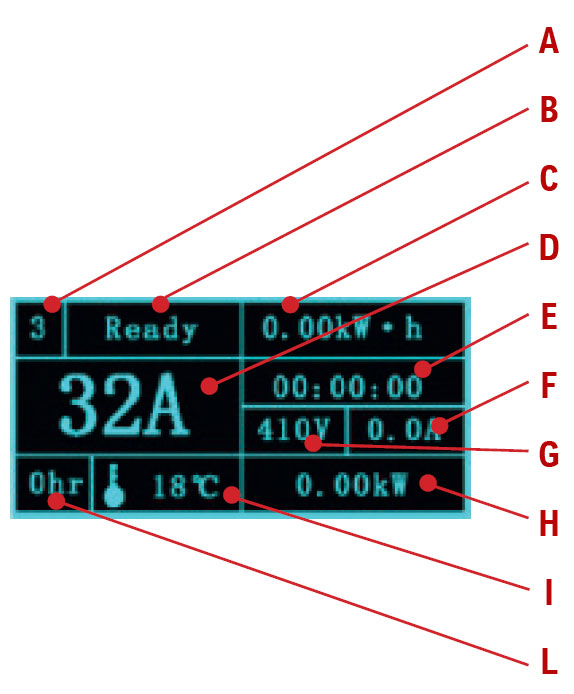
A: Number of phases
B: System status
C: Energy output (kWh)
D: Selected charging current
E: Charging duration
F: Instantaneous measured current
G: Measured voltage
H: Instantaneous measured charging power
I: Temperature
L: Delayed start
Possible system states
Ready
Led: steady blue
Power plug plugged in, device switched on and vehicle disconnected.
Connect
Led: blue flashing
Power plug plugged in, device switched on, connected vehicle on stand-by (not charging).
Charge
Led: blue scrolling
Power plug plugged in, device switched on, connected vehicle charging.
NOTE 1: The display automatically switches off after 2 minutes of inactivity.
NOTE 2: The display lights up automatically if there is a change of system status or if a key is pressed.
Warning messages
The EV1 / EV3 has numerous control functions to ensure maximum safety during its use.
If the EV1 / EV3 detects incorrect values, the corresponding parameters flash on the display to warn the user:
PHASES
Phase voltage deviating from normal value
Check outlet wiring and/or power line. Check for phase and neutral reversal.
TEMPERATURE
Board temperature between 70 °C and 80 °C
Check the ambient temperature and, if necessary, place the charging station in a ventilated and/or shady place to avoid overheating under certain environmental conditions.
VOLTAGE
Supply voltage out of tolerance
The supply voltage is above or below the following limits:
- Single-phase: 85 VAC - 265 VAC
- Three-phase: 150 VAC - 450 VAC
Error Messages
The following error messages are shown on the display in the event of an error or fault:
OVER TEMPER!!!
The board temperature is above 80 °C.
Please contact Customer Service.
POWER LEAK!!!
The earth fault current is above the permissible limits.
Please contact Customer Service.
UNKNOWN BOARD!!!
The circuit board in use is not the original.
Please contact Customer Service.
UNKNOWN CABLE!!!
The device's charging cable is damaged or cannot be detected by the device.
Please contact Customer Services.
HARDWARE ERROR!!!
The device hardware is faulty.
Please contact Customer Support.
OVER CURRENT!!!
The actual charging current is higher than the one set by the user.
Please switch off the device and check the electric vehicle.
NO GROUND!!!
The device is not grounded.
Please switch off the device and check the main power supply line.
Technical Data
| Charging mode | IEC61851 Mode 2 |
| Charging connector | IEC62196 Type 1 or Type 2 (depending on model) |
| Power input | Single-phase or three-phase, 230V-400V, 16A-32A (depending on model) |
| Power output | up to 7.4 kW (EV1) - up to 22 kW (EV3) |
| Earth Fault Protection | AC 30mA, DC 6mA |
| Dimensions | 90 x 270 x 60 mm |
| Weight | about 4 kg |
| Environmental protection | IP54 (outdoor use, rainproof) |
| Temperature | -30 °C to +50 °C |
| Compliance | CE |
Maintenance
EV1 / EV3 requires no specific maintenance, periodic cleaning is recommended.
Danger
Switch off the charging station by lowering the circuit breaker in the upstream electrical cabinet before cleaning the unit.
To reduce the risk of electrocution or damage to the device, take special care when cleaning the charging connector and its casing.
Clean the charging station using a soft cloth slightly moistened with a mild detergent. Never use any type of abrasive sponge, abrasive powder or flammable solvents such as alcohol or benzene.
Warranty
The manufacturer warrants this device to be free from defects in materials, workmanship and design for a period of 2 years from the date of purchase.
If defects in materials, workmanship and/or design occur during the warranty period, e-Station S.r.l. will, at its discretion, repair or replace the product.
Replacement parts and/or products may be new products or refurbished products at the discretion of e-Station S.r.l.
This warranty does not include repair service for damage caused by faulty installation, incorrect connection of devices, external electrical fault, accident, disaster, abuse, vandalism, unauthorised repair or modification by e-Station S.r.l.
Any evidence of attempt to open the product or unauthorised repair will invalidate this warranty.
Any liability for direct or indirect damage caused by a malfunction of any kind is excluded.